Data Volume Management
Data Volume Analysis
Pinpoint footprint reduction opportunities or plan a defensible system decommissioning — driven by AI-assisted analysis of your SAP landscape.
Book a Demo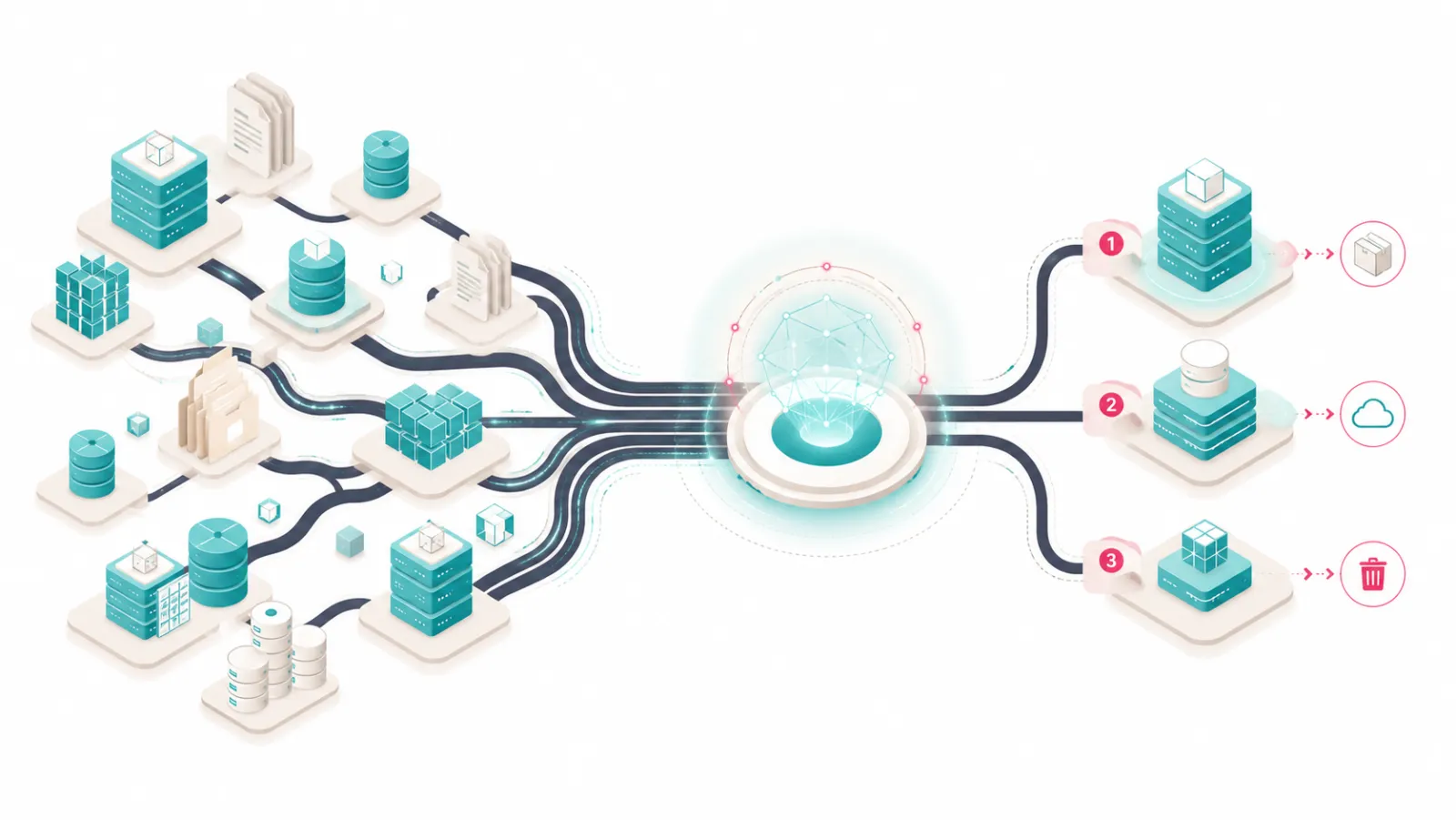
Whether you need to shrink the footprint of a running SAP landscape or retire a legacy system entirely, the first step is the same: understand exactly where data lives, what it is worth to the business, and how it must be preserved. Neev's Data Volume Analysis combines standard SAP reports, our proprietary DVM reports, and an AI-assisted Migration & Archiving Planner to deliver that answer in a fraction of the usual time.
Two variants, one Planner Agent
The Planner Agent supports two objectives. The underlying analysis and classification engine is the same — the outputs are tuned to the business outcome you care about.
DVM Variant
Identify System Footprint Reduction Opportunities
Targets running SAP landscapes where data growth is hurting performance, storage cost, and S/4HANA readiness. Standard SAP reports and Neev's proprietary DVM reports identify data growth hotspots, and the Planner Agent translates them into a sustainable footprint reduction strategy and roadmap, prioritized by business impact and effort.
- Sustainable footprint reduction roadmap
- Prioritized archiving objects by size and value
- Lower storage cost and improved SAP performance
Decommissioning Variant
Plan a Defensible Legacy System Decommissioning
Targets ECC and legacy SAP systems that are being retired or migrated to S/4HANA. The Planner Agent reads the full table landscape and produces a defensible plan covering what to keep, where to keep it, and how to keep it compliant — wave-by-wave, with named owners and governance gates.
- Defensible keep / archive / discard decisions
- Wave-sequenced decommissioning plan
- Audit-ready evidence for legal and compliance
Migration / Archiving Planner Agent
From raw SAP metadata to a prioritized, explainable plan
Our AI-assisted Planner Agent reads raw SAP DB02 and metadata extracts and converts them into an actionable plan that tells you exactly where to start and why.
Knowing what data to keep, where to keep it, and how to keep it compliant is the hardest part — whether you're reducing the footprint of a live system or retiring it for good. The Planner Agent turns months of manual analysis into hours by automatically reading your SAP table landscape and producing a clear, defensible plan.
Which tables are retention-relevant
Which SAP archiving object covers them
Which tables need JSON export or a custom archiving object
Which archiving objects to run first, prioritized by category and size
How the Planner Agent classifies your SAP tables
Every table is placed into one of five categories with a clear purpose and a recommended action — so retention, storage tier, and access strategy are explainable to legal, audit, and business owners.
System / Config
Purpose. Technical or customizing tables with no business retention value.
Typical action. Ignore or exclude from migration.
Backup Only
Purpose. Static or log tables with no time dimension or user reference.
Typical action. Retain compressed backup copy; no search index.
Reference Data
Purpose. Master or catalog data rarely queried after cut-over.
Typical action. Store as JSON catalog; load on demand.
Operational History
Purpose. Transactional data occasionally needed for look-ups or audits.
Typical action. Keep recent period indexed; archive older records.
Full Audit History
Purpose. Financial, legal, or compliance-critical information.
Typical action. Archive full history with search and legal hold enabled.
The result: enterprises gain clarity, compliance, and cost control — turning chaotic SAP data inventories into an actionable, AI-backed plan that accelerates system decommissioning and S/4HANA migration while proving due diligence.
What the analysis delivers
In a recent engagement, the Planner Agent processed a multi-terabyte ECC landscape and produced a fully sequenced plan in a fraction of the usual time.
Snapshot Plan Workbook
Wave summary, source-system summary, table-level plan, and a SARA/Neev Archive Automation runbook with archiving object, residence period, retention, owner, pre-checks, and post-checks for every table.
Executive Assessment Deck
An IT leadership-ready narrative covering footprint analyzed, largest table findings, preservation outcomes, what is ready to validate vs. what needs business confirmation, and a wave-by-wave sequence with governance gates.
Ready to Transform Your Data Life Cycle?
Join the hundreds of companies unlocking the full potential of their data with Neev.