Greenfield S/4HANA has a clean story. New system. New processes. A lean dataset. Keep S/4 fast by moving only open items and essential master data, and leave history behind in ECC.
That part works.
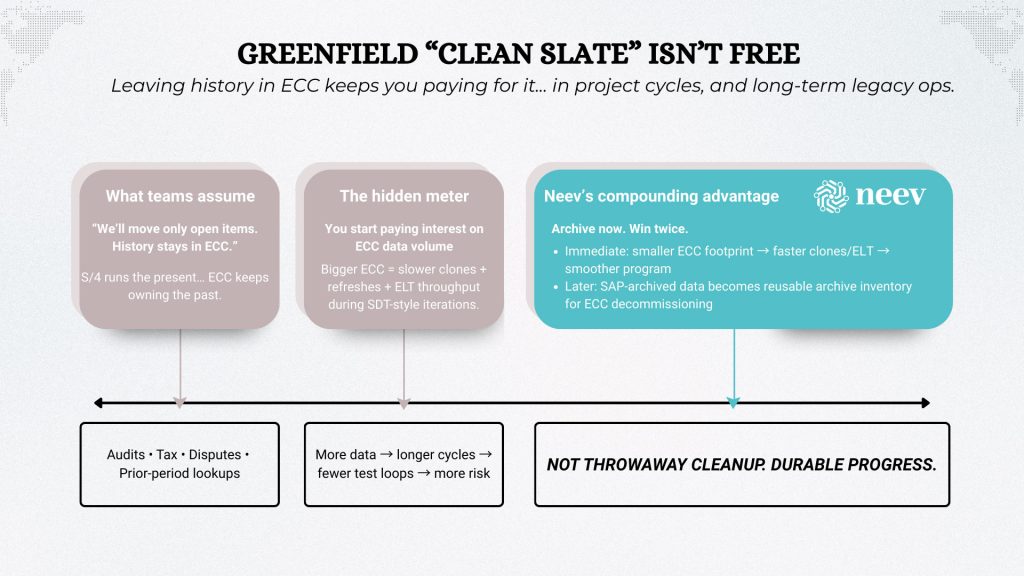
What does not work is pretending the history disappears. The business still needs it for audits, tax, disputes, prior-period lookups, and the occasional "prove it" question that shows up at the worst possible time. When that history remains trapped inside legacy ECC, you do not get a clean slate. You get a split world where S/4 is your present and ECC becomes the reluctant system of record for the past.
If you are doing system conversion, the mechanics and cost drivers are different. Read the brownfield edition here: The Hidden Cost of Delaying Data Archiving" Brownfield Edition..
Greenfield Does Not Eliminate Data Gravity. It Relocates It.
Most greenfield programs quietly land on the same operational compromise: "We will keep ECC around in read-only mode." That sounds responsible. It also becomes the largest unplanned operating cost of the program.
ECC in read-only is still ECC in production terms. It still needs patching. It still needs security controls and access reviews. It still needs backups, DR, monitoring, and the occasional incident response. If the system is in scope for audits, it is in scope for scrutiny. If it contains regulated data, it remains a compliance surface area even if your users only log in once a month.
This is where many greenfield business cases start leaking money. Not because S/4 is expensive. Because you end up funding two SAP worlds for far longer than anyone forecasted.
What "read-only ECC" really implies (in practice):
- Operational spend you didn't plan to carry (infra, backups/DR, monitoring)
- Security and control work that never goes away (patching, access reviews, audit evidence)
- Business dependency that quietly persists (someone always "needs to look up" something)
The Cost Shows up Before Go-Live, Inside the Project Engine
Greenfield is not "build once, cut over once." It is an iteration machine.
Even when your migration scope is limited, the program still relies on ECC throughout the build. Clones. Refreshes. Reconciliations. Extract validations. Integration testing. Dress rehearsals. Every one of those cycles depends on the current system being fast enough to copy, stable enough to validate, and small enough to repeat without burning weekends.
That dependence is easiest to see in programs that use a Selective Data Transition style approach for parts of the scope, or that simply behave like SDT programs during testing. You clone often. You load and validate often. You rerun the same test suites often. Your ELT timelines are directly tied to the size and churn of the source system.
A large ECC footprint makes that iteration loop slower. That is not philosophical. It is mechanical. Bigger databases take longer to back up and restore. System copies and refreshes take longer. Extract jobs take longer. Environments stabilize slower. Your team spends more time waiting for plumbing and less time testing business outcomes.
Every clone, refresh, and extraction cycle is paying interest on your ECC data volume. If you do nothing, you keep paying that interest through the entire program.
A quick hook to sanity-check this in your own program
If any of these sound familiar, volume is already affecting your timeline:
- Refreshes and copies are dictating the test calendar (not the other way around)
- Cutover rehearsals keep expanding because environments aren't ready in time
- Validation cycles are slower than the business expects, even with a limited scope
The "We Need More History" Moment Is Not a Surprise. It Is a Pattern.
Most greenfield teams start disciplined. Then the business asks for something completely reasonable.
Finance wants prior-year drilldowns in reporting. Operations needs older billing detail for a customer dispute. Audit asks for evidence from a closed period that never moved into S/4. Legal wants a complete chain for a case.
At that point, teams scramble into one of three paths:
- Keeping ECC alive longer than planned because it is the only trustworthy place to answer questions
- Building ad-hoc exports that live in shared drives and become permanent shadow processes
- Expanding the scope into selective history migration, which gets expensive quickly if the source system remains bloated
None of those outcomes are the clean slate you sold internally.
Where Neev Is Genuinely Different in Greenfield
Data archiving gets treated like housekeeping, so it is easy to push it out. That framing is the mistake.
When you archive high-volume objects in ECC now, you see immediate operational benefit in the current landscape. The live database footprint shrinks. The system behaves better. Refreshes get shorter. Copies get less painful. The iteration loop speeds up.
Neev's difference is what happens next.
Neev's legacy ECC decommissioning approach leverages SAP-archived data as a first-class input. Archiving high-volume objects now speeds up SDT clone/ELT cycles today and becomes reusable archive inventory that shrinks the decommissioning effort later — even if conversion is years away. In other words, you're not doing the work twice; you're front-loading the part that compounds.
A Quick Sanity Check: What "Delay" Looks Like in Dollars and Weeks
Greenfield leakage rarely appears as a single line item. It shows up as compounding friction.
You see it when system copies take longer and steal test cycles. You see it when cutover rehearsals expand because environments are not ready in time. You see it when an audit request forces you to re-open ECC access and rebuild brittle processes around a system you wanted out of the picture. You see it when leadership realizes the legacy platform is not "temporary" anymore.
Case Study Spotlight: a Regulated Greenfield Program That Avoided Zombie ECC
Regulated enterprise with strict audit/tax retention needs.
Front-loaded high-volume archiving in ECC
Targeted the objects driving footprint and operational drag, and made archiving repeatable (not a one-time cleanup).
Faster project iterations
Shorter refresh/copy/extract cycles during the program because ECC footprint and churn reduced.
Decades-old SAP ECC with a multi-terabyte footprint and no consistent archiving discipline.
Made history usable without ECC
Preserved, governed, audit-ready access to historical transactions and related content so teams didn't need ECC as the retrieval UI.
Clean S/4 core without losing history
Business and auditors retained access to legacy details without logging into ECC.
S/4HANA implemented clean; plan was to migrate only master data and open items, leaving historical detail behind.
Governance built in
Established policy-based retention and access controls so legacy history remained defensible for audits and compliance.
Lower long-tail cost and risk
ECC stopped being the default "history system," making retirement realistic instead of indefinite.
ECC was trending toward becoming a long-term "read-only" system that still required full security, controls, and infrastructure.
Compounding benefit
The SAP archive inventory created now becomes a reusable foundation later for ECC decommissioning.
Stronger end state
Clear path to decommission ECC with confidence, not keep it alive as a permanent liability.
This is the greenfield win most teams miss. Not a clean S/4 database. A credible legacy exit.
How to Approach Archiving in a Greenfield Program Without Derailing the Plan
The mistake is trying to boil the ocean. Greenfield teams do not need a perfect, multi-year archiving roadmap to get value quickly.
What works is starting with volume drivers that directly impact clone cycles and operational cost. High-volume transactional areas are usually the first to unlock because they dominate footprint and churn. Once archiving becomes repeatable and automated, it stops being a side project. It becomes part of keeping the current landscape lean while you build the next one.
The second decision is access. If the business cannot confidently retrieve historical data, you will keep ECC alive. That is why the archive layer has to behave like a governed system of record for history, with retention, residency, legal hold readiness, and audit trails aligned to your compliance posture.
Neev's approach is designed around those two constraints: repeatable archiving execution and usable access to history, so legacy decommissioning becomes a planned outcome instead of a hope.
The Real Definition of Greenfield Success
Greenfield is not complete at go-live. It is complete when the legacy system can be retired without losing defensible access to history.
Every clone and extraction cycle pays interest on ECC volume. Archiving now lowers that interest rate immediately. With Neev, that same work compounds because the archive inventory you build today becomes the foundation for decommissioning ECC later.
Need audit-ready history without keeping ECC alive? We'll map your retention and access requirements, validate the historical retrieval use cases that force ECC to linger, and propose an archive-first approach that stays defensible for audits while enabling legacy shutdown.