
Every CIO and IT leader preparing for a brownfield SAP S/4HANA migration has heard the same reassurance: "We'll handle archiving later." It sounds harmless, even practical, when the focus is on timelines, testing, and transformation. Yet postponing data archiving is one of the most expensive mistakes enterprises make. What appears to be a cost-saving shortcut before migration often turns into a long-term drain on performance, compliance, and budgets. The truth is simple: the longer you delay archiving, the more your data works against you.
Many organizations underestimate how deeply data shapes the complexity and cost of an S/4HANA migration. In the rush to modernize, data archiving often falls to the bottom of the priority list, viewed as an optional housekeeping task rather than a strategic enabler. The logic is easy to understand: with limited time and resources, teams focus on configuration, custom code, and infrastructure. But this short-term focus can lead to long-term consequences. Large, unmanaged data volumes make every stage of migration, from system sizing to downtime windows, harder, slower, and more expensive.
To truly optimize your S/4HANA journey, it's crucial to understand and avoid common mistakes companies make during migration.
Why Companies Delay Archiving
When discussing migration priorities, archiving rarely wins the spotlight. Many organizations delay it due to project fatigue, competing budgets, or the assumption that storage costs are manageable. Others worry that archiving before migration will slow down the project or create retrieval challenges later. However, the reality is the opposite: deferring archiving compounds complexity. Without a structured data volume management strategy, IT teams end up moving years of inactive data into a high-performance environment where it doesn't belong.
The Hidden Costs of Waiting
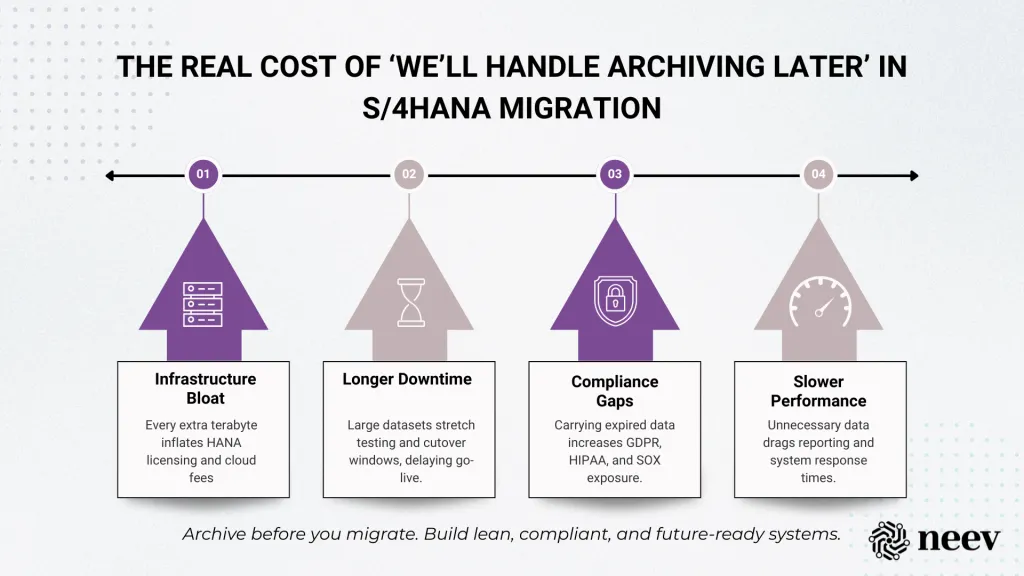
1. Inflated Infrastructure and Licensing Costs
Migrating massive datasets drives up both hardware and software expenses. Each extra terabyte inflates infrastructure sizing, cloud subscription fees, and HANA licensing costs across various system landscape tiers. When historical and inactive data is treated as production data, you're essentially paying enterprise rates for storage you don't need. Over time, this unnecessary data footprint creates millions in avoidable costs.
2. Longer Migration Windows and Downtime Risk
Large data volumes slow every step of the migration process: export, transform, and load. Extended cutovers mean longer business interruptions and a higher risk during go-live. Organizations that archive upfront experience shorter migration windows, faster testing cycles, and smoother transitions. The difference between archiving early and postponing it can be measured in weeks of project time and millions in productivity losses.
3. Compliance and Audit Exposure
Regulatory data management is not optional. Moving non-compliant or outdated data into S/4HANA magnifies exposure under frameworks like GDPR, HIPAA, and SOX. Without pre-migration archiving and controlled retention, organizations risk losing track of expired records or retaining sensitive data longer than legally allowed. Once that data is inside S/4HANA, remediation becomes more complex and costlier.
4. Post-Migration Performance Degradation
A lean database is a fast database. Carrying unnecessary data forward slows reporting, extends batch processing times, and strains system performance. Even the most optimized S/4HANA configuration can't compensate for a bloated data footprint. The end result: business users face slower transactions, delayed insights, and higher operational costs, all because archiving was deferred.
A Simple Analogy: Moving Without Decluttering
Think of S/4HANA migration like moving to a new office. Archiving is the process of sorting through your files before the move, deciding what's essential, what can be stored safely, and what can be discarded. Skipping this step may save time upfront, but it means paying to move clutter, finding space for it in your new office, and struggling with inefficiency once you're settled. The same principle applies to SAP data: what you carry forward determines how well your new environment performs.
Neev's Perspective: Turning Data Burden Into Data Leverage
At Neev Data, we've seen the cost of delay firsthand. That's why our approach is built around proactive data archiving as an integral part of migration planning, not an afterthought. Our Data Archiving as a Service (DAaaS) framework helps organizations reduce database size by up to 80% before migration, accelerating project timelines and reducing TCO. Using Neev Content Suite's automation-driven workflows, we ensure that every data decision aligns with compliance, performance, and business value.
With Neev's archive automation, enterprises can:
- Identify and archive inactive data using SAP data archiving through an easy to setup variants/jobs/batch cockpit
- Enforce residency, retention and legal hold policies easily
- Leverage serverless, cloud-native repositories for cost-efficient, compliant storage
- Maintain audit-ready access to historical data directly from S/4HANA or non-SAP interfaces
This approach enables faster S/4HANA migrations, cleaner system footprints, and measurable operational efficiency.
Actionable Insights for SAP Leaders
- Archive before you migrate. Every terabyte removed pre-migration saves exponential cost in infrastructure, licensing, and time.
- Treat archiving as compliance. It's not just about freeing space; it's about enforcing defensible retention, privacy, and governance.
- Automate and standardize. Manual archiving leads to inconsistency and risk. Automation ensures accuracy, auditability, and repeatability.
Key Takeaways
- Delaying archiving inflates infrastructure, cloud, and HANA licensing costs by treating inactive data as production data.
- Large data volumes extend migration windows, increasing downtime risk and productivity losses.
- Moving unarchived data into S/4HANA magnifies exposure to regulations like GDPR and HIPAA.
- Unnecessary data slows reporting, extends batch processing, and strains system performance post-migration.
A Smarter Path Forward
Delaying SAP data archiving doesn't eliminate the problem; it magnifies it. The organizations that thrive in their S/4HANA environments are the ones that treat data management as a strategic enabler, not a technical task. By taking action early, enterprises can transform migration from a reactive project into a proactive step toward sustainable modernization.
At Neev Data, we help businesses make that shift, from data burden to data leverage. If your S/4HANA migration is on the horizon, now is the time to start archiving smarter. Let's build a foundation that's lean, compliant, and ready for what's next.