
As we wrap up 2025, one theme is unmistakable across the industry conferences and countless customer conversations: the experimentation phase is over.
Most IT and data leaders are no longer asking: "Should we modernize?" or "Should we do AI?"
Those boxes are already ticked.
The questions now sound more like:
- How do we modernize without blowing up our SAP roadmap?
- How do we make AI useful without copying data into five different platforms?
- How do we reduce run costs and risk, while staying on the right side of regulators?
In our work across SAP landscapes and in our own writing this year, the same patterns have kept resurfacing. You can see them reflected in SAP's own roadmap and conference messaging, but more importantly, you can see them in the pains and priorities of real teams.
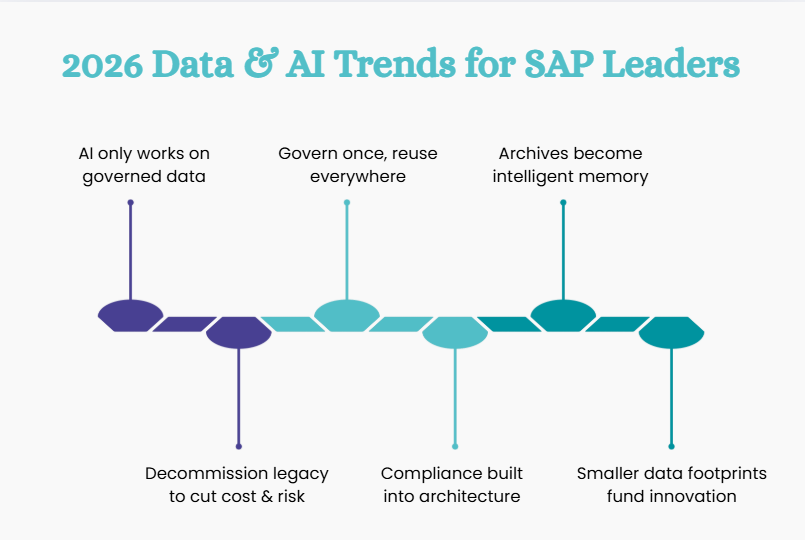
Here is a practical look at six trends that are shaping 2026, plus what you can realistically do about them, without turning your roadmap upside down.
1. AI Is Only as Good as the (Boring) Data Foundation Underneath It
It's tempting to start AI conversations with models, copilots, and agents. But the organizations that are actually getting value from AI all have one thing in common:
Their data is structured, governed, and understood.
That doesn't mean "perfect." It means:
- They know where key business data lives (ECC, S/4HANA, data lakes, archives, SaaS apps).
- They have at least a first pass at ownership, lineage, and retention rules.
- They've made intentional choices about which datasets are "reference-quality" and safe to reuse.
For SAP-heavy landscapes, this usually shows up as a proper data lifecycle, not just a full database and a prayer. That's why we see more teams treating data volume management in SAP as a strategic discipline rather than a housekeeping project. It's about keeping systems lean, reliable, and ready for what comes next.
What you can do in 2026
Pick one or two high-value domains (finance and order-to-cash are popular) and answer three questions:
- Where does this domain's data actually live today?
- Which version of it across its lifecycle should AI and analytics trust?
- What's the minimal work needed to make that dataset reliable and reusable?
If you start there, every AI project you run in 2026 will be on firmer ground.
2. "Govern Once, Reuse Everywhere" Is Replacing "Integrate Everything"
For years, each new initiative – analytics, compliance, AI, reporting, seemed to demand its own pipeline. New ETL. New copies. New integration debt.
We're finally seeing that pattern flip.
The emerging model looks more like this:
Govern a dataset once.
Expose it in consistent ways.
Let multiple use cases reuse it over time.
In SAP terms, that often translates to a unified extraction and governance layer: instead of one set of extraction and transformation jobs for archiving, another for S/4 migration, and another for analytics, you define a clear "source of truth" and let different consumers plug into it.
Practically, this often combines:
- In-SAP capabilities like Content Suite in SAP – lightweight, certified archiving and content management directly inside SAP.
- Platform-level lifecycle control via Data Volume Management in SAP and related purging/archiving approaches.
- Governance rules that apply equally to online and archived data, as in Data Governance and Compliance.
What you can do in 2026
Again, start small:
- Choose one domain.
- Define a governed dataset and persistence layer (e.g. blob store, data lake) for it.
- Design integrations and AI use cases to consume that, rather than creating clones.
You won't eliminate every duplicate overnight, but you'll start to break the "new project = new data copy" reflex.
3. Archives Are Becoming "Long-Term Memory," Not a Cold Graveyard
For a long time, "archive" meant "place data goes so we don't have to think about it again."
That mindset doesn't work anymore.
Regulators expect long-term access. Auditors expect fast retrieval. Business users want to see more than just last year's picture. And AI use cases increasingly need to look beyond the current database snapshot to be truly useful.
We're seeing more organizations reimagine archives as long-term memory:
- Payloads (files, print lists, large blobs) live on cost-efficient, lifecycle-managed cloud storage.
- An intelligent index (often JSON/document-centric, search-enabled, and increasingly vector-aware) makes it fast to find what matters.
- Access is secure, role-based, and integrated with enterprise identity and existing workflows.
This is exactly the role Content Suite in Cloud is designed to play: a scalable, cloud-native layer where you can bring together SAP and non-SAP history, search it intelligently, and still honor retention and privacy rules.
What you can do in 2026
Ask yourself:
- If an auditor needed 10-year-old transactions tomorrow, how painful would that be?
- Could an AI assistant safely "look back" across your history, or would it get lost in a maze of systems and file shares?
If the answers make you nervous, choose one process, say, P2P(PO/IR/GR) or O2C(sales document flow – Quote, Order, Delivery, Billing), and pilot a more modern archive/search experience for that area. Treat it as your first "long-term memory" project.
4. Legacy Decommissioning Is Now a Business Problem, Not Just an IT Wish List
Every large organization has them: systems that nobody loves, everybody pays for, and nobody quite dares to turn off.
They're often kept alive for three reasons:
- "We might need the data."
- "The auditors might ask questions."
- "We don't have time to figure out a better way."
Meanwhile, they quietly drain the budget, add security risk, and block simplification.
The reality is that decommissioning is becoming business-critical. It's surfacing in board-level conversations about cost, cyber risk, technical debt, and cloud strategy, not just in IT backlog grooming. That's exactly why Neev has an entire offering focused on decommissioning legacy systems: a structured way to retire systems while keeping data accessible and compliant.
What you can do in 2026
Don't try to boil the ocean. Instead:
- Pick one legacy system that everyone informally agrees "should go."
- Work with compliance, audit, and business stakeholders to define what must be retained and for how long. Show up with a plan as opposed to a blank slate.
- Move that content into a governed archive/search platform (for example, combining SAP-embedded access with Content Suite in Cloud).
- Have users validate that their needs are met—then formally switch the legacy system off.
That single success story will make it much easier to tackle the second, third, and tenth system.
5. Compliance Is Moving Into the Architecture, Not Just the Policy Binder
Data privacy and retention rules have been with us for a while, but the combination of:
- more aggressive regulators,
- more distributed data, and
- more powerful AI/automation
is forcing a shift.
It's no longer enough to say "we comply." You have to encode that compliance into how systems are built:
- Retention rules that apply consistently to online and archived data.
- Legal holds that actually prevent deletion when they should.
- Masking and anonymization that make non-production use safe.
- Auditable paths when AI or agents touch sensitive information.
This is exactly the focus of our data governance and compliance solutions: data masking, retention management, and secure support for corporate transformations like carve-outs and mergers, all tuned to SAP realities.
What you can do in 2026
Take one domain and walk through its lifecycle:
- How is residency, and retention decided?
- How are archiving and purge decisions executed?
- What happens when data is archived or moved to another platform?
- Could an AI initiative accidentally bypass those rules?
You'll almost certainly find gaps, but you'll also find clear, tractable places to improve.
6. Shrinking the Data Footprint Is the Easiest Way to Fund the Future
When cloud bills and infrastructure renewals are under scrutiny, data bloat suddenly becomes very visible.
Big SAP databases slow down upgrades and backups. Overgrown archives keep everything forever "just in case." Storage tiers that were cheap at small scale become painful at petabytes.
The good news: this is one of the most controllable levers you have.
A structured approach to data volume management and data purging & disposition can:
- Reduce SAP system database sizes dramatically.
- Move cooler content to cheaper storage tiers.
- Shorten backup windows and cut disaster recovery complexity.
- Make S/4HANA or cloud migrations significantly less risky.
And it's not just SAP. The same principle applies to other ERPs, analytics platforms, document stores, and archives: keep hot data close and small; push cold data to more economical layers with smart indexing on top.
What you can do in 2026
Set one simple goal:
"By the end of 2026, our core systems will be 30% smaller and 20% faster, not just newer."
Then back into it with concrete steps: automated archiving, smarter retention, workload-aware storage tiers, and a clear policy for what gets to live on your most expensive infrastructure.
Putting It All Together
Taken together, these trends point in a clear direction:
- AI sits on top of solid, governed data.
- That data is extracted and curated once, then reused across use cases.
- Archives stop being cold storage and start serving as intelligent long-term memory.
- Legacy decommissioning becomes a lever for simplification and savings.
- Compliance stops being a paragraph in a policy and becomes part of the architecture.
- Data volume management becomes a primary funding source for modernization.
You don't need a giant transformation program to start moving this way. In fact, the most successful organizations we see tend to focus on one domain, one archive, one legacy system at a time—and then scale out from there.
Where Neev Fits Into Your 2026 Story (Without Making It All About Us)
Neev exists in the middle of exactly these challenges:
- Helping SAP customers keep systems lean with data volume management in SAP and automation-driven archiving.
- Providing both SAP-embedded and cloud-native ways to manage content through Content Suite in SAP and Content Suite in Cloud.
- Supporting safe, structured decommissioning of legacy systems without losing critical data.
- Wrapping it all in robust data governance and compliance so retention, masking, and legal holds don't get left behind.
If these trends resonate with what you're seeing inside your organization, a simple next step is to choose one of them and explore it more deeply – whether that's a focused data volume assessment, a decommissioning POC, or a first "long-term memory" archive.
And if you'd like a sounding board as you shape your 2026 roadmap, we're here for that conversation too.