Most SAP integration designs focus on getting today's transactions flowing between systems. But the newest pressure on enterprise data isn't just operational speed, it's intelligence: analytics teams, copilots, and automated decisions all demand a complete, trusted picture that includes live records, archived history, and decommissioned-system data.
When you only integrate the online tier, you end up training dashboards and AI on partial context, which shows up as shaky metrics, incomplete explanations, and slow root-cause analysis right when the business needs clarity. That's why integrating data from all tiers should be treated as a first-class requirement, not a cleanup task after the "real integration" is done.
SAP's own framing of enterprise integration is broader than point-to-point connections, it's about connecting applications, data, clouds, APIs, processes, and devices across the landscape with a common governance model.
So let's talk about SAP integration the way it shows up in real operations: how SAP data moves (and stays trustworthy) across your entire enterprise, across all tiers, not just what's online today.
The Three Tiers of SAP Data You're Really Integrating
Most enterprises don't have "SAP data" in one place. They have it across tiers, each with different performance, access, and retention requirements.
| SAP data tier | What it includes | Why it matters for "seamless ops" |
|---|---|---|
| Online (hot) | Current transactional + master data in ECC/S/4 | Drives daily workflows, customer response times, fulfillment, finance close |
| Archived (warm) | Archived business data + related documents (invoices, POs, attachments) | Critical for audits, disputes, customer service, and long-tail reporting |
| Legacy / decommissioned (cold) | Data from retired SAP or non-SAP systems kept for history | Same purpose as the Archived (warm), but eliminates "keep the old system running just for lookups" |
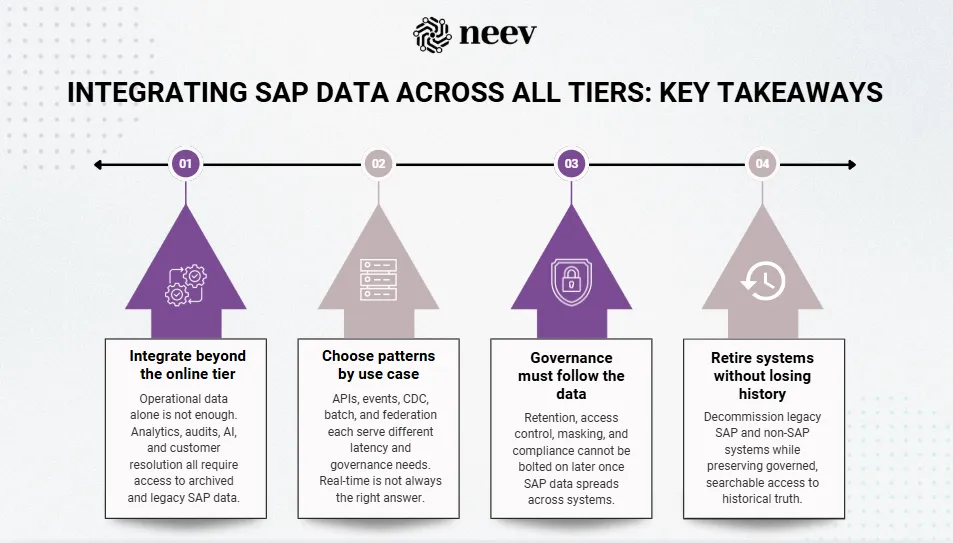
This is where a lot of integration programs quietly fail: the online flows get modernized, but the archive/legacy tier is treated as an afterthought, until the first audit request or customer escalation.
If you're already fighting performance issues, extraction windows, or database growth, getting serious about data volume management in SAP is usually step one. It's hard to integrate cleanly when the core is constantly under load.
Integration Options, Explained in "Data Movement" Terms
Instead of listing tools, it's more useful to think in patterns, because your pattern choice drives latency, governance, and operational reliability.
| Pattern | Best for | Typical latency | Common watch-outs |
|---|---|---|---|
| APIs (request/response) | Transactional reads/writes, validations, real-time apps | Seconds | Versioning, auth sprawl, API governance |
| Events (pub/sub) | Business moments ("order created", "goods issued") | Near real-time | Idempotency, replay strategy, monitoring |
| CDC / replication | Operational reporting, near real-time analytics feeds | Seconds – minutes | Deletes/updates, ordering, spike handling |
| Batch ETL/ELT | Backfills, finance reconciliation, warehouse/lake loads | Minutes – hours | Late data, duplicates, heavy extracts |
| Virtualization / federation | Query-in-place for selective use cases | Near real-time | Performance and access controls |
| Files / EDI | Trading partners, regulated exchanges | Hours – days | Exception handling and reconciliation |
A practical takeaway: don't aim for "real-time everything." Aim for the right latency per use case, and make it observable. SAP's ERP integration guidance reinforces this point: modern landscapes need scalable integration methods (often iPaaS) as app ecosystems grow, and API management becomes essential to avoid "code spaghetti."
Where SAP Integration Suite Fits (and Where It Doesn't)
SAP Integration Suite is SAP's integration platform approach for building and governing integration flows, APIs, and event-driven patterns. SAP also highlights event mesh capabilities as part of Integration Suite for asynchronous, real-time communication at scale.
It's a strong fit when you want:
- a SAP-aligned integration operating model
- centralized monitoring/governance for integration flows and APIs
- consistent patterns across cloud + hybrid environments
But it's not a magic answer for archived/legacy access. Integration platforms move data, they don't automatically solve lifecycle access, retention rules, or "how do we find historical truth quickly?"
SAP Business Data Cloud (SAP BDC): the Data Foundation Story (Analytics + AI)
SAP Business Data Cloud (SAP BDC) is positioned as a way to unify SAP and third-party data and provide a trusted foundation for analytics and AI, SAP's announcement emphasizes semantically rich "data products" across business processes and embedded capabilities through partnerships like Databricks.
The clean mental model is:
- Integration Suite = moving/mediating operational flows (APIs/events/process integration)
- SAP BDC = harmonizing and packaging data for analytics/AI (governed data products)
Quick acronym warning (because it will come up)
SAP teams also use BDC to mean Batch Data Communication (classic batch input). That's a legacy automation technique, not the same thing as SAP Business Data Cloud. It's worth spelling this out once so the project doesn't spiral into terminology confusion.
The Failure Points That Break "Seamless Operations" (and How a Data-First Approach Fixes Them)
1) "Everything works… until someone needs archived history"
Auditors, disputes, customer service, legal, ML models that rely on historical data – these are archive-heavy moments. If archived data can't be accessed quickly and consistently, the business feels friction even if the online integration is perfect.
This is exactly why teams carve out dedicated capability to retrieve SAP archived data rather than treating it like a one-off request.
2) Data governance gets bolted on after data is already everywhere
Once SAP data flows into analytics tools, CRMs, procurement platforms, and shared stores, governance becomes operational, not theoretical. You need consistent rules for access, retention, and auditability.
A good anchor is data governance and compliance services to ensure the lifecycle rules follow the data, not the other way around.
3) Sensitive fields spread into places they shouldn't
Even "normal" integration (customer, HR, vendor, finance data) can create unnecessary exposure in downstream systems or non-production environments.
That's where data masking in SAP HANA (and ECC) becomes a practical integration enabler, because it lets you move what you need while reducing risk.
4) Legacy systems stay alive just for lookups
Old SAP instances and adjacent legacy apps often remain online for one reason: "we still need the data."
That's expensive and risky. A cleaner pattern is decommissioning the app while preserving governed access to historical data through a modern access layer, what legacy system decommissioning is all about.
5) No one plans for end-of-life data actions
Retention schedules, legal holds, and defensible deletion are part of "seamless ops," especially when data flows outside SAP.
That's why mature programs include data purging and disposition in the same conversation as integration patterns.
A Simple Decision Guide (So You Don't Overbuild)
If you're deciding how to integrate SAP with another system, these questions get you to the right pattern quickly:
- Is this process execution (writes/transactions) or analytics/AI?
- What's the required latency: seconds, minutes, hours?
- Is archived/legacy history part of the user journey?
- What governance rules apply (privacy, retention, audit)?
- Who owns monitoring, retries, and reconciliation?
If the answer includes "audits," "history," "legal," or "customers calling about something from 3 years ago," then your integration design must include a plan for archive + legacy access, not just operational sync.
A Practical Next Step:
Take your top 10 SAP integration use cases and label each one with:
- which data tier it touches (online / archive / legacy)
- the latency it truly needs
- the governance rules that apply
That one exercise usually reveals the real gaps, before production (or audit season) does.
Where Neev Fits
Neev Data helps enterprises keep SAP data usable across its full lifecycle, online, archived, and decommissioned, while staying compliant and operationally fast.
That naturally maps to:
- keeping systems lean through data volume management
- making history accessible via archived data retrieval
- enforcing lifecycle controls through data governance and compliance solutions
- reducing exposure using data masking
- retiring old landscapes with legacy system decommissioning
If your integration program is moving SAP data into more places than ever (cloud platforms, warehouses, partner apps), those lifecycle capabilities stop being "nice-to-have." They're what keeps operations smooth under pressure.
A lot of integration programs optimize the present tense: what's happening right now in SAP. Seamless operations also require the past tense: archived records, historical truth, and decommissioned-system access that still matters.
When SAP data moves across your enterprise, the real win is keeping it usable and compliant across every tier, not just the live system. Talk to Neev Data if you'd like a quick review of your integration approach and where data lifecycle gaps might be hiding.