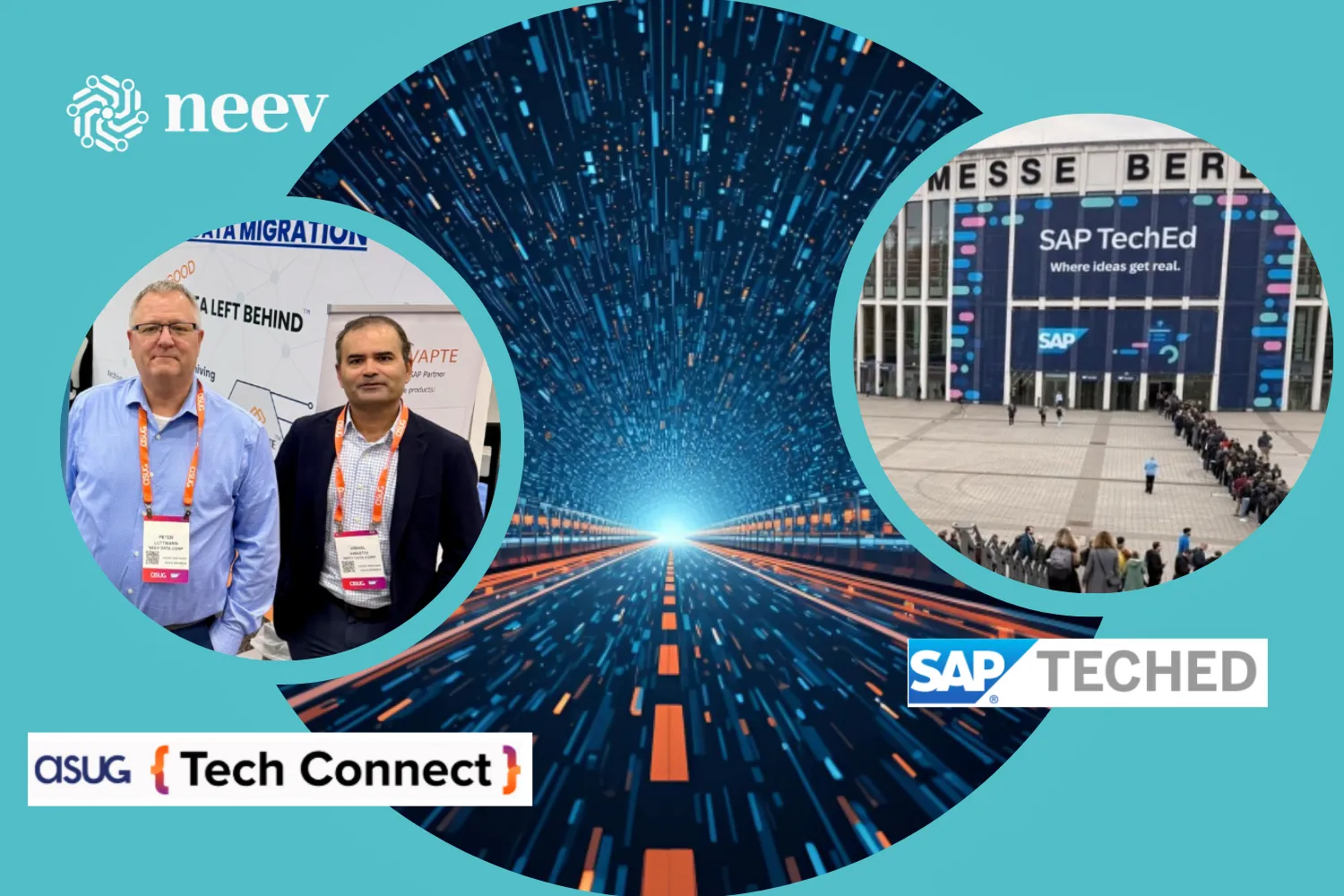
Two SAP events – Tech Connect in Louisville and TechEd in Berlin – unfolded almost simultaneously this year.
One delivered hands-on insights from partners and customers modernizing SAP landscapes, the other unveiled SAP's strategic roadmap for AI, data, and extensibility.
Taken together, the two shows told a remarkably consistent story:
SAP's future is unified, intelligent, and increasingly dependent on governed, reusable data.
Below are my reflections across both events, with a specific perspective on topics we focus on at Neev every day – SAP data, archiving, modernization, and automation.
1. From Dual Workstreams to a Unified Extraction Layer
At Tech Connect, discussions with customers at our booth and post sessions were refreshingly aligned:
they want to stop running two separate extraction efforts – one for archiving and one for migration.
The "One Extraction. Two Outcomes." mindset resonated strongly:
- Extract once from ECC
- Govern once
- Use the same validated dataset for archiving, SDT migration, analytics, and future reuse
This shift isn't just an efficiency improvement – it's a strategy.
It reduces reconciliation cycles, avoids duplicate work, and sets up organizations for reuse across the lifecycle.
What struck me is how well this practical customer demand now mirrors SAP's own messaging at TechEd.
2. Business Data Cloud and SAP's Zero-Copy Principle
One of SAP's strongest signals this year is the move toward zero-copy data access within Business Data Cloud (BDC).
The idea: stop moving data around; let tools and models access governed datasets in place.
This aligns precisely with where the broader ecosystem is heading – data should be authoritative, connected, and reusable – not duplicated.
Even patterns we see in our own work, such as our roadmap on exporting archived datasets in Parquet into HANA Data Lake (HDL), map naturally to this future: one governed source, many consumers, zero duplication.
3. RPT-1: Structured-Data AI Arrives
SAP's announcement of RPT-1, its relational pretrained transformer model, is arguably the most important AI update of the show.
RPT-1 is designed not just for unstructured text, but for SAP's world of tables, joins, relationships, hierarchies, and transactional context.
For enterprises with decades of ECC and S/4 data, this is significant:
- Structured historical data becomes an asset for AI
- High-quality archive data can fuel future reasoning
- The value of well-governed legacy data only increases
AI is finally coming to where the business actually lives: inside structured systems of record and related unstructured content outside.
4. Joule Agents, Joule Studio, and the Ecosystem of "SAP-Aware Automation"
TechEd devoted enormous attention to Joule and the new Joule Agents framework – SAP's move to operational, task-driven, SAP-contextual AI automation.
Key updates included:
- Custom agents in Joule Studio (GA in December) with AI-assisted design, triggers, A2A flows, monitoring, and MCP support
- Pro-code agents using open-source frameworks like CrewAI and LangGraph, with SAP identity/governance
- MCP Gateway enabling agents to use custom APIs, legacy SAP data, and 3rd party systems
- Joule for Developers supporting ABAP, Java, JS, with AI-driven custom code migration
This is early, but meaningful.
At Neev, we're quietly exploring how future Joule Skills could streamline access to archived SAP content – allowing users to query historical or decommissioned data conversationally rather than navigating screens.
Too early to talk publicly about, but aligned with where SAP is heading.
5. SAP Build, Extensibility, and a More Open Developer Experience
TechEd also revealed a pragmatic trend – developers want their own tools. SAP is letting them have it – with governance.
Announcements included:
- SAP Build opened to curated AI coding assistants like Cursor, Windsurf, Claude Code
- SAP Build for VS Code (extensions for CAP, Fiori, UI5, Mobile)
- AI in Workzone for content summaries and insights
- Prompt optimizer + no-code AI testing playground
This signals a more open SAP developer experience – with governance rails intact.
6. HANA Cloud MCP: Multi-Model Access for Agents and AI
A quieter but important announcement was MCP for SAP HANA Cloud, enabling agents to interact with:
- relational
- document
- graph
- spatial
- vector
…data models inside one in-memory engine.
This was perhaps the clearest proof that SAP wants AI to operate directly on governed enterprise data – not on isolated exports or unmanaged data lakes.
Again, this matches where many of us are heading: unified, multi-model access without extra copies.
7. Integration Suite: AI-Driven Resilience
TechEd also emphasized:
- Self-healing integrations
- Joule-powered anomaly detection
- Pattern-based recommendations in API Management
These updates matter for S/4 transformations, where integrations often become the long tail of project risk.
Synthesis: Two shows, one direction
Across both events, a coherent pattern emerged:
- Tech Connect showed real-world demand for simplification in data extraction, archiving, and migration
- TechEd showed SAP's bet on unified data, agentic AI, and zero-copy access
The alignment is striking:
| Market Need (Tech Connect) | SAP Direction (TechEd) |
|---|---|
| One extraction for archiving + migration | Zero-copy access in Business Data Cloud |
| Reusable, governed datasets | RPT-1 relational AI model |
| Simplified user interaction | Joule Agents + Skills |
| Open, flexible development | Build + VS Code + open code assistants |
Both signals point to the same future – govern once, reuse everywhere – for compliance, migration, analytics, and AI.
This year's TechEd and Tech Connect made it clear that SAP's data and AI future is converging around simplicity, governance, and reuse.
Whether we call it zero-copy, a unified extraction layer, or simply good data discipline, the direction is unmistakable.
The more intelligently we extract, govern, and retain data today, the more capable our intelligent systems will be tomorrow.