We were back at Javits this week for MongoDB.local NYC. Dev Ittycheria's recap underscored three items that matter directly to our customers: MongoDB 8.2, Search + Vector Search for self-managed deployments (public preview), and the Application Modernization Platform (AMP). MongoDB also highlighted first-party Voyage AI embedding models and rerankers aimed at higher-quality retrieval for AI applications.
What Changed This Year (and Why It Matters)
- Search + Vector Search for self-managed: Public preview brings the same unified retrieval pattern (keyword + vector) to Community Edition and Enterprise Server via the mongot sidecar. For regulated or on-prem environments, this reduces friction and avoids running an external search stack.
- First-party embeddings and rerankers: Voyage AI models are now part of the platform story, improving recall and ranking quality for RAG and agents.
- AMP (Application Modernization Platform): A structured path for modernizing legacy applications and data into the MongoDB platform, supported by AI-assisted tooling and services.
How Content Suite in Cloud Uses MongoDB
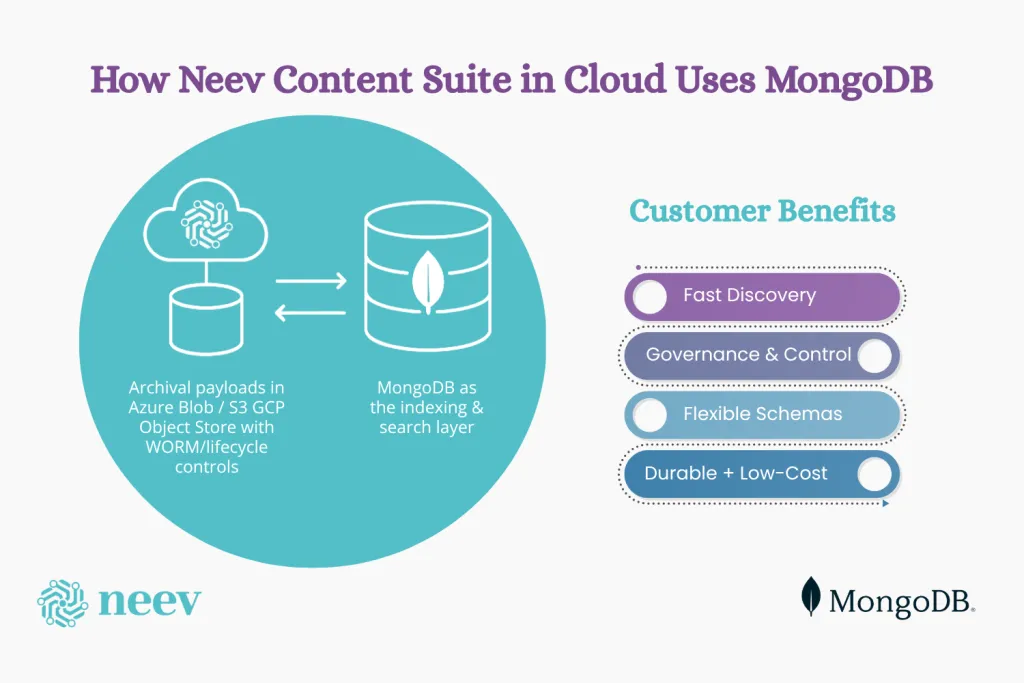
Our architecture keeps archival payloads in tiered object storage (Azure Blob or S3) with WORM/lifecycle controls and uses MongoDB as the indexing and search layer. This gives us:
- Fast discovery across decades of SAP and non-SAP records (metadata, derived attributes, and references to binary content).
- Stable, low-cost durability for the heavy bits in object storage.
- Flexible schemas to represent multi-system history without fragile joins.
With self-managed Search + Vector Search now in preview, customers who cannot use Atlas still gain semantic retrieval capabilities on-prem or private cloud. We will support this path where it simplifies operations and governance.
"Ask the Archive" and Agentic Workflows
Two near-term improvements benefit from these releases:
- Ask the Archive: Better embeddings and rerankers improve answer quality and reduce latency for conversational access to historical documents, policies, and transactions.
- Agentic helpers for compliance and migration: Native search/vector plus high-quality embeddings make tool-using agents more reliable (long-term memory, short-term working context, and grounded actions).
Side Note – Badge Earned!
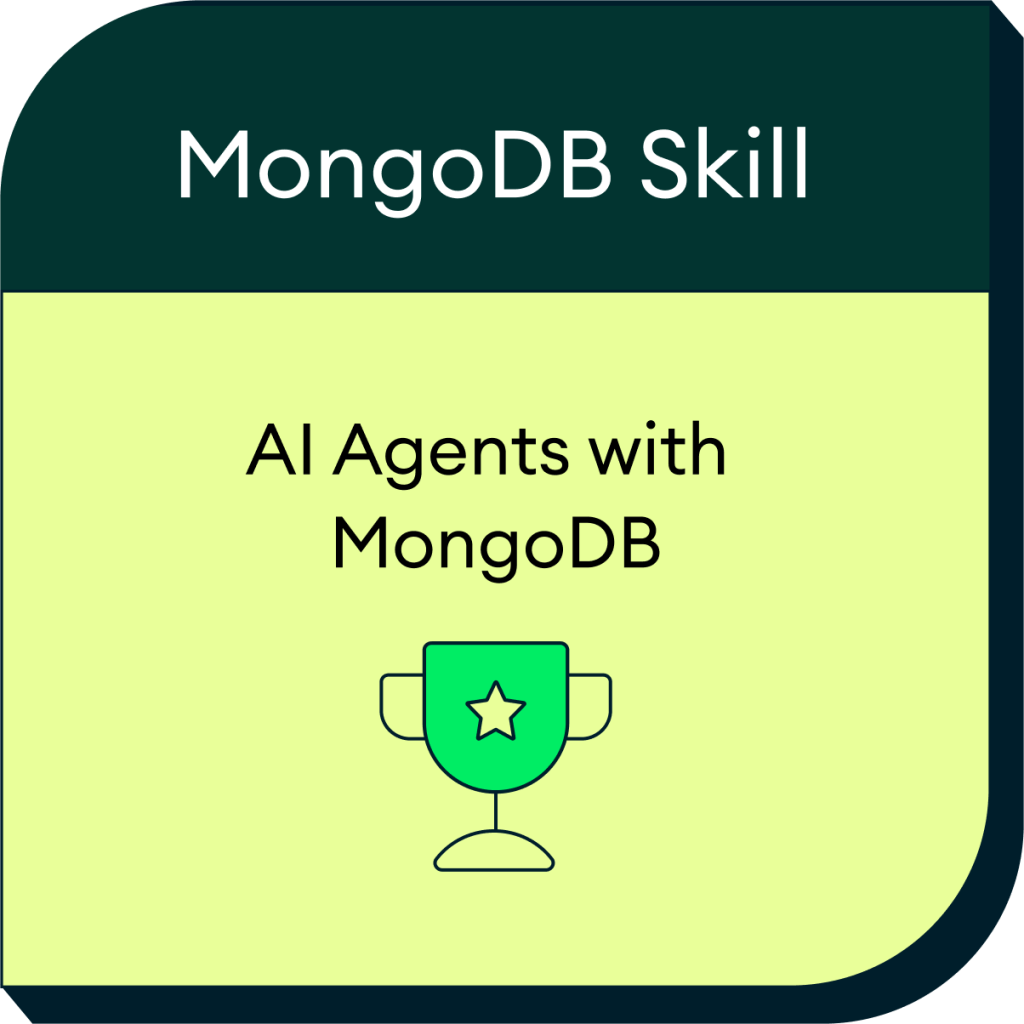
While I no longer actively code, I attended an insightful hands-on workshop on Agentic AI and earned the "Building AI Agents with MongoDB" credential. This badge validates hands-on skills in creating a multi-tool agent backed by MongoDB data, defining decision logic across tools, and implementing long-term and short-term memory on MongoDB. It was fun getting first-hand experience in building agents and gave me lots of ideas I can't wait to share with our product team.
AMP vs. Neev's Decommissioning: Complementary Motions
MongoDB's AMP accelerates modernization into the MongoDB platform. Our Approach One focuses on safe decommissioning of legacy systems while preserving complete, queryable history for audit, legal, and business access. In practice, many estates need both motions: retire risk and cost now, then modernize targeted workloads with clear boundaries.
New: Shrinking Oversized MongoDB Clusters (and the 16 MB Document Limit)
We see increasing spend from oversized collections, very large documents, and cold history kept online. We are formalizing a MongoDB Collection Shrink & Archive offering that:
- Profiles hot vs. cold data, indexes, and query paths.
- Right-sizes documents and arrays to steer clear of the 16 MiB BSON document size limit and pathological growth patterns (splitting, bucketing, and externalizing large blobs).
- Archives cold slices to object storage while maintaining lightweight index stubs in MongoDB for seamless retrieval.
- Reduces index bloat and rebuilds only what plans actually need.
Expected outcomes: smaller working sets, faster backups, lower storage costs, and more predictable performance—without losing compliance-grade history.
What This Enables for Our Customers
- Higher-quality retrieval for Q&A over multi-decade archives (embeddings + rerankers).
- On-prem viable semantic search where Atlas is not an option (self-managed preview).
- Clear separation of concerns: decommission safely now; modernize what matters with AMP later.
Taken together, the NYC announcements validate the direction we have been pursuing: durable archives in object storage, MongoDB as a fast, flexible index, and AI features that make historical data actually usable. Over the next quarter we will fold native embeddings and self-managed search/vector into Ask the Archive, expand our agentic helpers for compliance and migration, and pilot our Collection Shrink & Archive offering with a few large clusters. Our goal is simple: reduce risk and cost while increasing the speed at which your teams find and use trusted records. If you are weighing modernization with AMP, decommissioning with our Approach One, or a hybrid, we are happy to review your landscape and share concrete patterns and benchmarks.