
Managing data in SAP landscapes is becoming increasingly complex. As enterprises accelerate digital transformation and prepare for S/4HANA, they face mounting pressure to control data growth, streamline archiving, and ensure long-term access to historical records.
SAP addresses this challenge through its Data Volume Management (DVM) framework, where data archiving is the only proven method for reducing database footprint and ensuring long-term data availability. At the core of this approach is the SAP Archive Development Kit (ADK), the technical foundation that defines how data is extracted, structured, and stored outside the active database. Yet despite this central role, many IT and compliance teams still lack a clear understanding of ADK's fundamentals and its impact on performance, accessibility, and audit readiness.
So, the critical question is: Do you truly understand the role of SAP ADK files in ensuring your archived data is structured, retrievable, and transformation-ready?
Why Archiving Demands More Than Just Data Storage Optimization
Many organizations assume that archiving data is simply about reducing database size. While storage optimization is important, modern archiving demands more. It's not just about what data is retained, but how it is stored, where it resides, and how quickly it can be retrieved when needed.
In SAP environments, the Archive Development Kit (ADK) is the backbone of effective data archiving. It defines how data is written from the SAP database into archive files, ensuring integrity, structure, and long-term retrievability. Without understanding ADK's role, organizations risk:
- Retaining data longer than necessary.
- Failing to retrieve documents within regulatory timeframes.
- Storing archives in unsecured or non-compliant formats.
- Failing to apply data privacy policies on archived data.
- Failing to apply carve-out rules during divestitures.
What Are SAP ADK Files?
Let's simplify with an analogy:
Imagine moving sensitive legal documents into a fireproof, labeled cabinet. The cabinet isn't just storage—it's structured for easy but secure retrieval, protected against damage, and standardized so anyone in the organization knows how to use it.
That's the role ADK plays for SAP data.
SAP ADK files are standardized containers generated by the Archive Development Kit. Think of ADK files as secure, structured vaults: they package archived data in a way that maintains context, integrity, and compatibility across SAP versions.
Key properties of ADK files include:
- Consistency: Data is extracted using SAP's archiving objects, ensuring no loss of relational integrity.
- Security: Files can be encrypted, checksum verified, and stored in compliant repositories.
- Retrievability: Archived data remains accessible through SAP transactions and reporting tools.
- Portability: ADK files can be integrated with certified storage and archiving solutions.
One limitation, however, is that ADK files are typically only readable within the SAP system they originate from, making it difficult to leverage archived data outside its native environment. This prevents reporting and analytics on this data from the new S/4HANA system, or from external BI tools.
How ADK Files Enable Effective Archiving in SAP
When integrated with automated archiving processes, ADK files become the foundation of effective archiving in SAP landscapes—supporting not only compliance, but also performance, governance, and audit-readiness.
- Retention Policy Enforcement. ADK files can support ILM and/or storage layer's native retention rules, ensuring data is only retained for the legally required period. Once retention expires, data can be purged in a controlled and auditable way.
- Secure and Efficient Storage and Access. Highly compressed ADK files can be stored in certified and modern archive solutions, such as Neev's on-premise disk or cloud-native content repositories. Combined with SAP embedded or SaaS/Cloud based RBAC access options, they prevent unauthorized access while ensuring audit readiness. Additional software-based WORM features can be enforced at the storage level.
- Audit-Ready Retrieval. Whether an internal auditor requests transaction histories or regulators demand proof of compliance, ADK files enable quick retrieval through standard SAP interfaces. This minimizes the operational disruption and risk associated with audits.
Real-World Example: A mid-sized manufacturing company preparing for its S/4HANA migration leveraged Neev's data archiving automation based on SAP ADK. By identifying and archiving 60% of its inactive data, the company reduced the migration data volume by more than half. This led to a faster, less disruptive migration and a leaner S/4HANA environment—while keeping archived data fully accessible for audit and regulatory purposes.
ADK in Action: Supporting S/4HANA Migration and Legacy Decommissioning
Compliance doesn't stop with daily operations; it extends into transformation projects. SAP S/4HANA migrations and legacy system decommissioning create heightened compliance risks if not managed with discipline.
S/4HANA Migration:
By archiving inactive data into ADK files before migration, organizations reduce database size and ensure only compliant, relevant data moves forward. This avoids carrying redundant records into the new system.
Legacy System Decommissioning:
With an SDT (selective data transfer) approach, organizations often maintain legacy applications purely to access historical records. By exporting data into ADK snapshots and storing them in modern content management software, companies can safely retire legacy systems without losing compliance visibility.
Case Study: A multinational manufacturing company successfully decommissioned multiple SAP legacy applications using Neev's legacy system decommissioning solution while leveraging SAP's ADK framework. The project archived and centralized critical historical data into an accessible, modern repository—resulting in a 60% reduction in operational costs and secure access to legacy data for audits and reporting.
Best Practices for Leveraging ADK Files in SAP Archiving Strategy
To maximize compliance and efficiency, enterprises should:
1. Automate Archiving Processes
Use archiving automation to schedule, monitor, and enforce business rules for ADK-based archiving. This eliminates human error and ensures consistency.
2. Integrate Data Governance Policies
Align archiving rules with enterprise-wide data governance and compliance frameworks. Data governance and compliance services can help map regulatory requirements into ILM rules.
3. Deploy Certified Storage Interface Solutions
Pair ADK archives with certified data archiving software and cloud repositories to ensure security, scalability, and audit readiness.
4. Enable User-Friendly Retrieval
Ensure that business users can access archived records seamlessly via archive search applications, reducing the burden on IT.
Beyond Compliance: Operational Efficiency
While compliance is a driving factor, the benefits of ADK-based archiving extend into performance and cost optimization:
- Database Reduction: Smaller databases mean faster upgrades, backups, and migrations.
- Cost Savings: Lower licensing tiers, reduced infrastructure costs, and fewer legacy systems.
- Agility: Faster access to relevant records empowers decision-making and operational responsiveness.
When combined with document automation, data masking, and retention governance, ADK-based archiving creates a holistic framework for secure, efficient, and compliant data management.
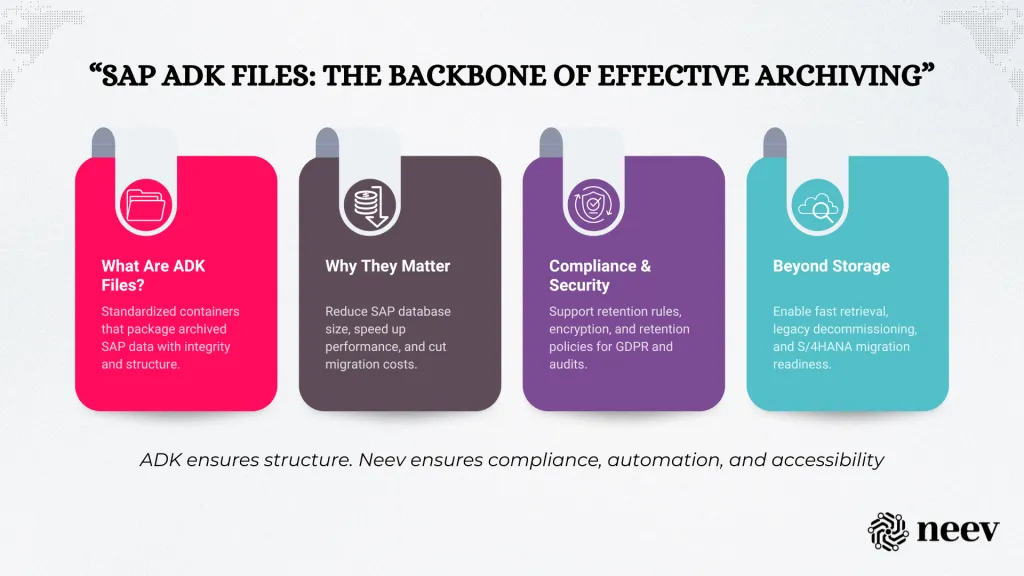
ADK and Neev: the Compliance Backbone of SAP Archiving
For CIOs, IT directors, and compliance leaders, SAP ADK files are not just technical artifacts—they are the foundation of a compliant and efficient SAP archiving strategy.
While ADK files provide the structure, it's the surrounding architecture that unlocks their full potential.
That's where Neev Data steps in.
With decades of SAP expertise and a suite of certified, SAP- as well as cloud-native tools, Neev transforms ADK archiving from a compliance necessity into a business enabler:
- Automation-first approach: Neev's Archive Automation tool streamlines and schedules SAP archive jobs with granular controls—reducing manual effort and human error.
- Retention and legal hold enforcement: Using Neev's ILM-integrated framework, enterprises can enforce retention rules, manage legal holds, and automate defensible data deletion.
- Serverless, certified cloud archiving: Neev's serverless archive platform eliminates costly middleware while providing scalable, compliant storage across AWS, Azure, and GCP.
- Embedded access and retrieval: Neev's ArchiveAccess solution empowers business users to search and retrieve archived records directly via SAP GUI or Fiori, ensuring audit-readiness without IT bottlenecks.
- Cross-platform ADK access: Unlike standard ADK, which is restricted to its source SAP system, Neev enables archived content to be consumed beyond SAP by transforming ADK files into SHA-256 verified open JSON standard. Business users can query archived data from a new S/4HANA system or directly from Neev's SaaS platform—enabling flexible reporting and analytics.
100% SAP-based deployment with the option to extend search to non-SAP users via SaaS components: Delivered as a certified add-on, Neev's solutions integrate seamlessly with ECC and S/4HANA environments without external servers or infrastructure. As an additional option, Neev's Content Suite in Cloud can extend similar search to non-SAP stakeholders.
Together, these capabilities ensure that ADK files aren't just stored, they're governed, encrypted, searchable, and accessible—all while keeping your compliance posture rock solid.
SAP ADK and Neev Data: Enabling End-to-End Compliance
The table below summarizes how SAP ADK provides the foundation for archiving — and how Neev enhances it to deliver full compliance, automation, and operational readiness:
| SAP ADK Capabilities | What Neev Adds on Top of ADK |
|---|---|
| Structured Archiving Format – Reliable archiving via SAP-defined objects | Custom Archiving Automation – Schedule, monitor, and manage jobs using Neev's Archive Automation framework |
| Retention via ILM Rules – Supports rule-based retention and deletion | Simplified Retention & Legal Hold Enforcement – Automates deletion and holds following corporate compliance policies without requiring full SAP ILM, WebDAV storage, or ADK conversion |
| Secure File Structure – Supports ArchiveLink-certified storage | Serverless Cloud Archive – Secure, scalable storage with no middleware, plus encryption and compression at rest |
| Retrievability via SAP Interfaces – Accessible via AS_AFB, ALO1, or selected SAP transactions | Embedded Search & Fiori UI – Business-user retrieval without IT dependency from a wide variety of SAP applications |
| SAP ArchiveLink Protocol Compliance – Ensures certified API access | 100% SAP-native Deployment – Delivered as ABAP add-ons, with no external servers required |
| System-locked Accessibility – ADK content is typically only readable in its source SAP system | Cross-platform Access & JSON Transformation – Enables archived content to be consumed from S/4HANA or Neev's SaaS platform via open JSON standards |
At Neev Data, we design and deploy SAP-native archiving and document management strategies that ensure your data is stored securely, retrieved efficiently, and governed effectively. Whether your priority is audit readiness, migration preparation, or long-term cost reduction, our solutions help you achieve truly modern SAP archiving.
Let's talk about how Neev can help modernize your SAP archiving.